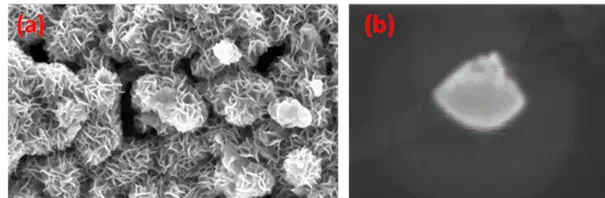
In the first year of the project, we are screening semiconductors and co-catalysts for the hydrogen evolution reaction (HER). Platinum is the state-of-the-art catalyst for hydrogen evolution in electrolysers. However, use of platinum as a co-catalyst across large area photocatalyst sheets is not appropriate due to its scarcity, environmental impact and high cost. Finding a low cost, abundant co-catalyst is an important milestone in PH2OTOGEN’s goal to achieve sustainable hydrogen evolution.
Molybdenum sulfides (MoSx) are highly promising precious metal-free catalysts for HER, having demonstrated low overpotentials and excellent stability with metal doping with elements such as Co, Fe, Ni, Zn, N, P further improving the performance.
During the project we have prepared (doped) MoSx via a variety of synthesis methods: i. microwave synthesis; ii. exfoliation of bulk MoSx into few layer sheets and measured promising performances through electrochemical methods. As a next step, we will explore how to deposit these effectively onto photocatalysts
Figure 1. Field Emission Scanning Electron Microscope (FESEM) micrographs of (a) Bulk MoSx synthesised by microwave synthesis (b) Exfoliated MoSx sheets. Scale: (a) image width 2.8 µm, (b) object width 130 nm.Ching Thian Moi, postdoctoral associates at CEA Grenoble, in STEP team
Pascale Chenevier, researcher at CEA Grenoble in nanosciences